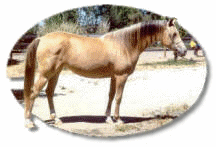
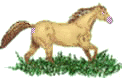
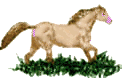
First: The "Pure" Champagne Colors
|
 |
 |
 |
 |
|
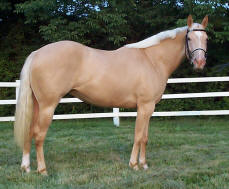
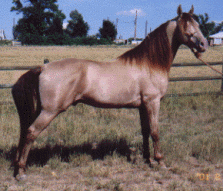
GOLD
chestnut/sorrel + champagne |
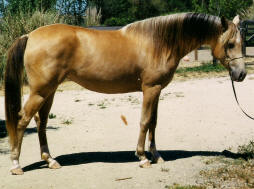
AMBER
bay + champagne |
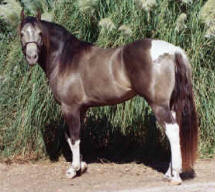
SABLE
(seal) brown + champagne |
CLASSIC
solid black + champagne |
This page has
an overview of the four "pure Champagne" colors,
which result from the action of the Champagne gene
on chestnut,
bay, brown, and black.
(See chart below or photographs above)
For details about each color, click on the
photo, link, button or drawing representing that color.
    
For "other Champagne colors" : see "Combinations"
Effect of Champagne on the four
simplest horse colors:
|
Base Color
These horses will have dark or black skin
in all
pigmented areas. |
With Champagne
These horses will have pink skin
with darker freckles
in all pigmented areas. |
Starting with a red horse (a chestnut / sorrel) :
|
ee
|
If the red-based horse has one or two champagne genes from one or both parents,
it's
Gold.
(Occasionally a gold may have a red mane and/or tail.
We call this "dark Gold".)
|
ee, Ch_
|
Starting with a black horse with a bay (agouti) gene:
|
E_, A_
|
If the bay-based horse has one or two champagne genes from one or both parents, it's
Amber. |
E_, A_, Ch_
|
Starting with a black horse with
a (seal) brown (agouti-t)
gene, and no bay gene: |
E_, AtAt or Ata
|
If the brown-based horse has one or two champagne genes from one or both parents, it's
Sable. |
E_, AtAt or Ata, Ch_
|
Starting with a black horse without a
brown or bay gene: |
|
If the black-based horse has one or two champagne genes from one or both parents, it's
Classic. |
|
Genetic notation used: E = black, e
= red; A = bay, At = brown, a = solid; Ch =
champagne, ch = non-champagne; __ = any version of same gene
Links to DNA tests
to identify your horse's base color and other modifiers are
HERE.
Depending upon which base colors and other color modifiers
are present in a
horse with a Champagne gene, the appearance of the horse varies.
Also, a
lighter or darker shade of the "original" color will affect the horse's appearance.
Since the Champagne gene is believed to be a
North American mutation, occurring once,
sometime around 1890, a horse must have at least
one ancestor (parent, great-grandparent, etc.)
of North American bloodlines to be an genuine Champagne
color.
Click this link to read more. |
Otherwise, continue learning
about the Champagne Colors, below:
For in-depth help in determining
whether a horse is champagne, see "Identification"
|
|