Horse Color Basics + Champagne
Note: for those interested in an in-depth explanation of the technical
aspects of the champagne mutation, see this PDF by Deborah Cook, Samantha
Brooks, Rebecca Bellone, and Ernest Bailey, working out of several different
universities: CLICK HERE
added
Monday, November 06, 2017
 * *
Genes
All characteristics, including color, are inherited through GENES, which are
located in pairs on microscopic structures inside of cells, called CHROMOSOMES. They are found in the nucleus of
every cell, and made up of strands of DNA. Genes exist in pairs.
However, the specialized-for-reproduction nucleus of an egg or a sperm cell
has only one of each gene from the individual producing it.
Horses, like all mammals, get one of
each gene from the mother, and one of each gene from the father, ending up with
a pair for every possible characteristic.
Red vs. Black (E vs. e)
All horses have RED (e) pigment in their coats, manes and tails; and many
also have BLACK (E).
Red-only is usually called CHESTNUT,
and is the same, according to presently known genetics, as SORREL.
Colors like Palomino, Gold (champagne) and
red dun are built upon this red-pigment-only base.
Horses with BLACK pigment also include bay,
brown, and solid black, and all modifications of those, such as Amber
(champagne), brown cream, and grulla.
These exist as one pair of genes on every horse's chromosome. They
determine what pigment is present in a horse's hair.
GENE WARS? Dominant and recessive genes
So, what if a horse gets a red-hair gene (e) from its father (sire), and a
black-hair gene (E) from its mother (dam)?
Because, in horse color, BLACK is a DOMINANT gene, which means it will
always show itself whether there are one or two of them, it will have
black pigment.
But what about that red gene (e)? RED is RECESSIVE in horse color, which
means that it can only show up if there is no dominant (E) gene at that "spot"
(the red-black spot).
So, the only horses that will be RED (and its derivatives) are ones that get a red gene from BOTH
parents. Two red genes are needed to make a red horse. (ee)
These two make black-based horses: EE or Ee.
Modifying black: Agouti (bay, brown, or solid)
We've only discussed one LOCUS (spot where a pair of genes exists) on the
horse's chromosome, so far: the E/e locus. Now we move on to another one,
the AGOUTI locus, which contains a pair of genes that only affect black pigment.
This means that if a horse has only red pigment (is "ee" at the red/black
locus), the genes at the agouti locus have no effect on that horse's color.
If the horse DOES have an "E" gene, meaning it does have black pigment, the
agouti genes affect it as follows:
-
A, or the BAY AGOUTI gene, when present on a horse with an E (black
pigment) gene, will limit the black pigment to the points (mane, tail, lower
legs) of the horse. A/bay is the "most dominant" of the agouti genes,
and will always be active when it's present.
-
At, or the BROWN AGOUTI gene, when present and active
(no A gene) on a horse with an E (black
pigment) gene, will allow the black pigment to spread over most of the body,
but restrict it on the muzzle and underbelly, etc., causing those areas to be a
tan color. At/brown is the "second most
dominant" of the agouti genes, and will be active if no A/bay gene is
present
-
a, or the BLACK AGOUTI gene, when present and active (no A ot At
gene) on a horse with an E (black pigment) gene, allows the black pigment to
spread through every bit of the horse's coat. This produces a solid
black horse, or one of its derivatives, depending upon what other genes are
present at other loci. a/solid black is the RECESSIVE gene at the
agouti locus, and will only be active when no A/bay or At/brown
gene is present (aa only).
Just as black is dominant over red at the red/black locus, bay is dominant
over brown and solid black, and brown is dominant over solid black, at the
agouti locus.
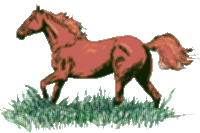 |
Chestnut (or "sorrel")
(ee) red pigment only
any agouti; has no effect on red
|
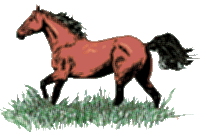 |
Bay
(EE or Ee) black pigment
(AA, AAt or Aa) bay
agouti
|
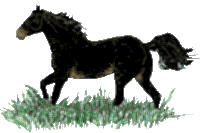 |
Brown
(EE or Ee) black pigment
(AtAt or Ata) brown agouti
|
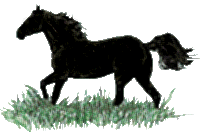 |
Black
(EE or Ee) black pigment
(aa) two solid (black) agouti
|
Enter the Champagne Gene!
The Champagne gene dilutes red to a golden color, and black to a brown or
dark taupe color.
The Champagne gene is also dominant. So if a horse has even one
Champagne in the pair, it will be a Champagne horse. Ch is the genetic
code for Champagne
and ch stands for non-Champagne, so:
-
Ch+Ch = Champagne horse
-
Ch+ch = Champagne horse
-
ch+ ch = non-Champagne horse
Now let's look at combinations of all of these:
The
Red/Black, the 3 Agoutis, and the Champagne genes.
NOTE: on this web
site, as in most genetic notation, an underlined blank spot like this: ___
indicates that it doesn't matter which of the other genes of that
pair is present.
Example: an E_ A_ horse will be bay,
and could actually be any of these:
EE AA (bay)
EE AAt
(bay)
EE Aa (bay)
Ee AA (bay)
Ee AAt
(bay)
Ee Aa (bay)
Effect of Champagne on the four basic horse colors:
|
Base Color
Without
a Champagne gene, or any other color-modifying gene. These horses will have dark or black skin in all
pigmented areas. |
With Champagne
These horses will have pink skin with darker freckles
in all pigmented areas, especially abundant on the face & privates. |
Starting with a red based horse (a chestnut / sorrel) :
|
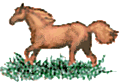
ee |
If the red-based horse has one or two champagne genes from one or both parents, it's
Gold. (Occasionally a gold may have a reddish mane and/or tail.)
|
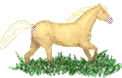
ee, Ch_ |
Starting with a black based horse with a bay (agouti) gene:
|
E_, A_ |
If the bay-based horse has one or two champagne genes from one or both parents, it's
Amber. |
E_, A_, Ch_ |
Starting with a black based horse with the (seal) brown (agouti-t)
gene: |
E_, At_ |
If the brown-based horse has one or two champagne genes from one or both parents, it's
Sable. |
E_, At_, Ch_ |
Starting with a solid black horse
(without an agouti gene): |
|
If the black-based horse has one or two champagne genes from one or both parents, it's
Classic. |
|
More examples:
EE AA ChCh (homozygous for all of these dominant genes)
This horse has two black genes, two bay genes, and two Champagne
genes. So it has black pigment, but only on the points (bay) and that black
will be diluted to dark brown (Champagne). The body is left red by
the bay gene, so the Champagne gene makes the body a golden/tan
color. This horse is an Amber! It may be mistaken for
a buckskin, but it has brown points, not black, and pink skin with
freckles.
Every one of its foals will be bay based & champagne -- some
variation of Amber -- no matter what color mate it's bred to,
because every one of its foals will have an E, an A, and a Ch gene
from it, which are dominant over all other genes at each of those
loci.
Ee Aa Chch (heterozygous for all genes)
This horse has one each of these dominant genes, so it is the same as
the one above, because a dominant gene always shows!
There is a 50% chance that any one of its foals could get
any
one of its genes ... and since some of those are recessive, the
genes of the other parent could be dominant over those, determining
its color.
Ee Ata Chch (heterozygous for all genes)
This horse is black based, and champagne, but since the At
gene is dominant over the a gene, and there is no A gene, it is
a brown-based champagne, or Sable.
There is a 50% chance that any one of its foals could get
any
one of its genes ... and since some of those are recessive, the
genes of the other parent could be dominant over those, determining
its color.
ee (?) Chch (homozygous for red, agouti unknown, heterozygous
for champagne)
This horse has no black pigment (ee is red, which blocks black when there
are two and thus, no E) so we cannot tell by looking
at it whether it
has the bay gene or brown gene or neither (A, At or a). It
would require a close look at its parentage & progeny, or an agouti test. It does have a Champagne gene, so the red
is diluted to gold. This horse will be a Gold. Often
mistaken for Palominos, these horses may or may not have flaxen (white) manes
& tails.
As with any mammal, there is a 50% chance that any one of its foals could get
any
one of its genes ... and since some of those are recessive, the
genes of the other parent could be dominant over those, determining
its color.
Champagne test now available!
None of the ICHR's conclusions have been disproved by this test; and, there is now a
foolproof way to prove our conclusions. See the link(s) to the test here:
http://www.ichregistry.com/color_test_info.htm
The following horses have been DNA tested and found to be homozygous for the
champagne gene.
This means that they CANNOT HAVE A NON-CHAMPAGNE FOAL.
Every single one of their foals will be
a champagne color of some kind.
216 - Brooke's Sunny Sue
263 - Champagne Shadowfax
342 - Jocitas Bit O Honey
407 - Dancer's Mystique
499 - Skippin the Bars
601 - Champagne Cloud Dancer
662 - Banner's Sippin' Champagne
227 - Champagne De Oros ("Brie")
- Ima Rebel Cougarand
328 - Champagne Easter
|







 Emailing
ICHR
Emailing
ICHR